
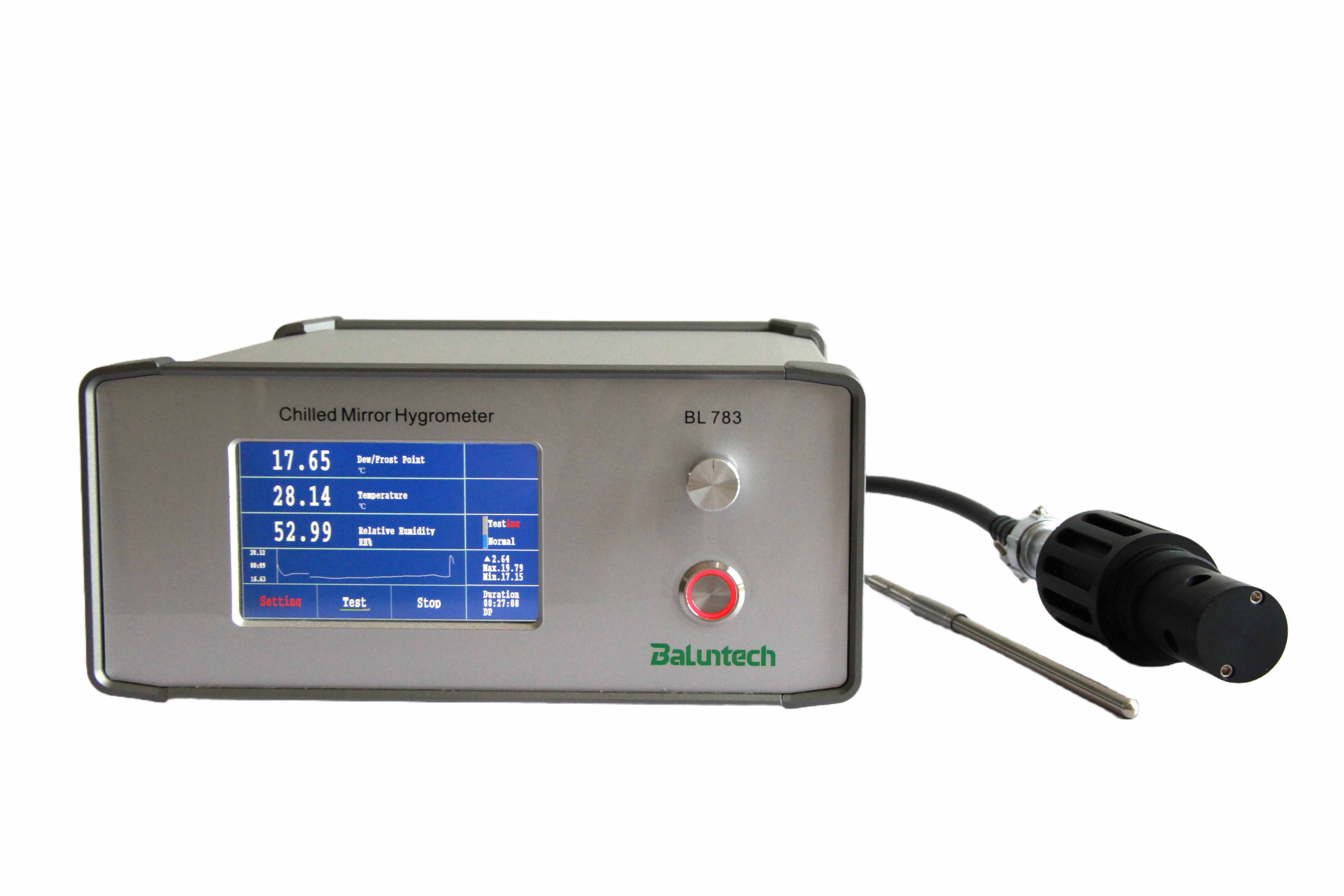
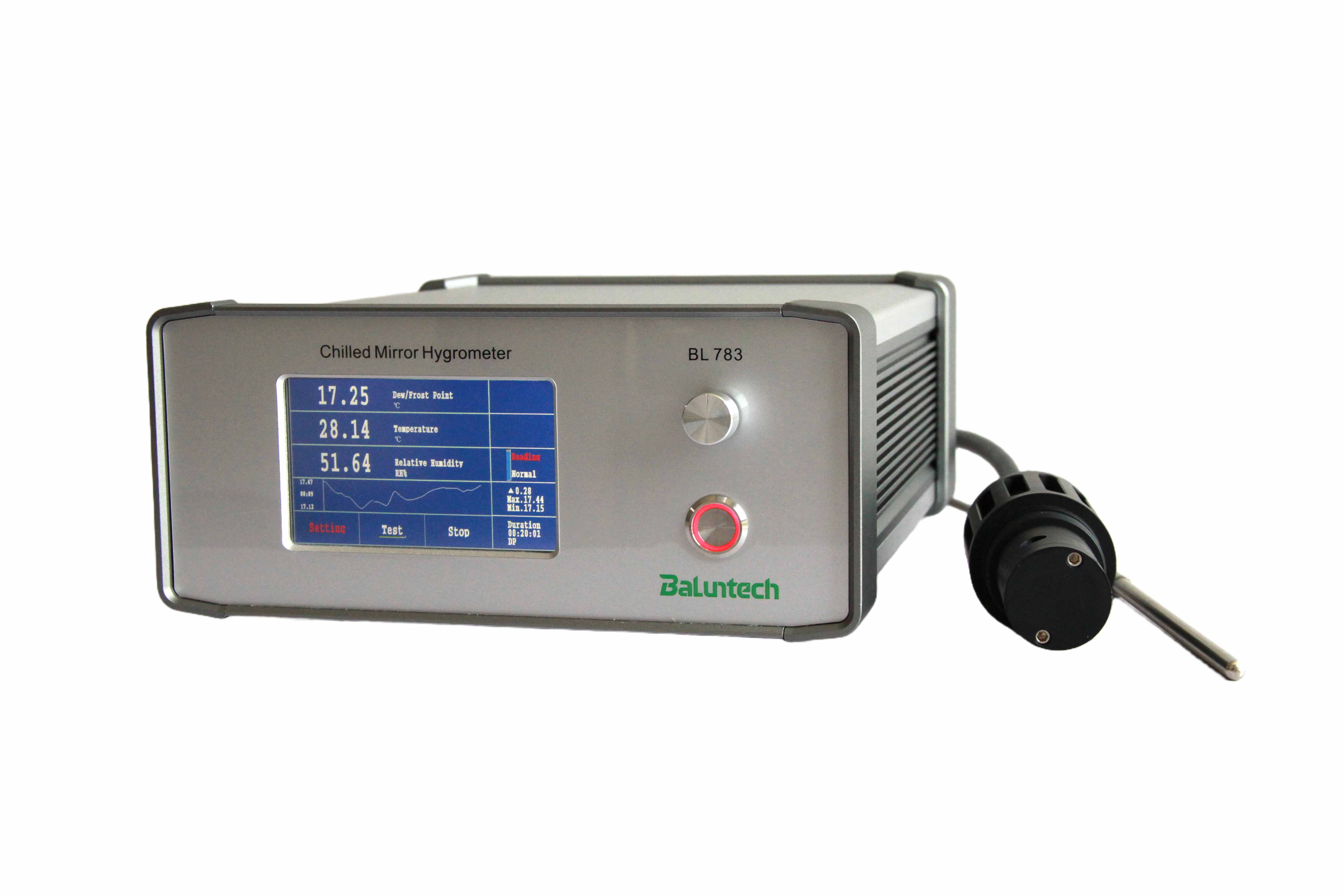
BL783 Chilled Mirror Hygrometer (±0.15℃ dp)
Chilled mirror hygrometry is a precise technique for determining the water vapor content is gases by directly measuring dew point or frost temperatures. Using this technique a metal mirror is cooled until it reaches a temperature at which a thin layer of condensation begins to form on it. The dew layer is detected optically, and the mirror is held at that temperature. The mirror temperature, measures with a PRT, is an accurate indicator of the dew or frost point.
FEATURES
Dew point measure range -40℃ to +90℃
±0.15 ℃ accuracy from -20℃ to 65℃.
Dynamic balance control for contamination
Simultaneously measures dew point, temperature, relative humidity, absolute humidity, and precipitable water vapor
Real time data logging and display curve
MAX value and MIN value are recorded
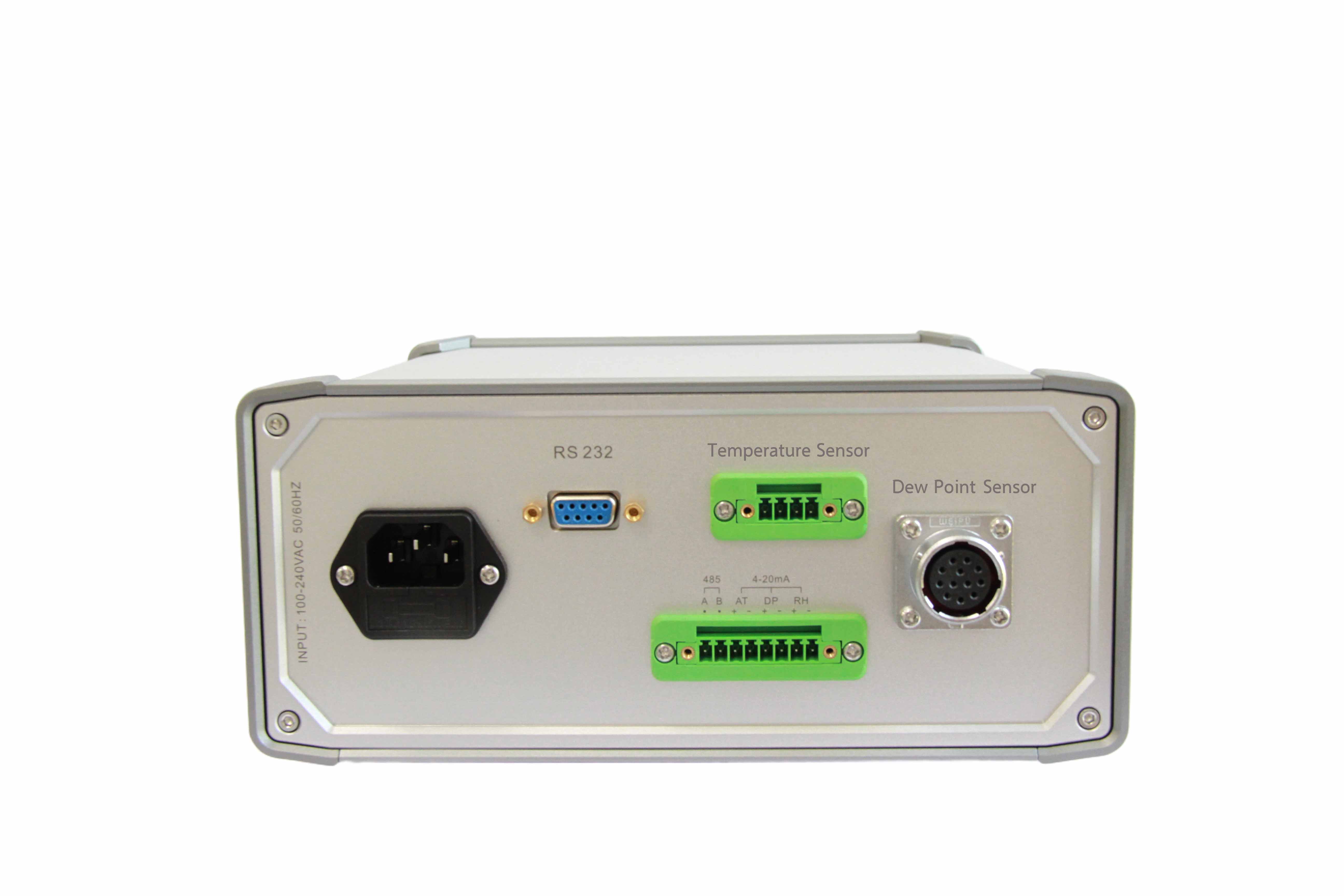
RS232 and RS485 communication
Force frost function at low dew point
Auto process the super cool water
4-20mA analog output for AT, DP and RH%
APPLICATION
Reference standard in calibration lab
Inlet air measurement for engine testing
Heating ventilation and air conditioning test
Environment monitoring in clean room
Humidity control for metallurgical processes
Coating process monitoring in pharmacy
Reference humidity instruments for climatic and environmental chambers
SPECIFICATION
DP/FP ranges: -40℃ to +90℃
DP/FP accuracy: ±0.15℃ (calibration: -20℃ to +65℃)
DP/FP resolution: 0.01℃
DP/FP reproducibility error: ±0.05℃
Temperature range: -45℃ to +100℃
Temperature accuracy: ±0.05℃ (calibration: -10℃~90℃)
Temperature resolution: 0.01℃
Temperature reproducibility error: ±0.05℃
Working environment: -20℃ to +60℃, 10%RH to 90%RH, 101.325kPa
Mirror temperature measurement: 4 wire PT100 1/3B
Depression: Two stages, 65℃ at 25℃
Cooling type: Peltier cooling
Probe material: SUS304 stainless steel
Cable material: Polyurethane material with shielding layer
Response time: Max cooling 0.8℃/s, + 15s balance time
Sampling airflow rate: 0.1~1NL/min (The volume of ventilation is inversely proportional to the dew point)
Flow rate control method: Touch screen, Knob
Analog output: 4-20mA for AT, DP and RH%
Communication interface: RS232, RS485
Power supply: 100-240V AC
Ingress protection grade: IP54
Dimension: 257mm (W) x 90mm (H) x 220mm (D)
Net Weight: 2kg
Shipping weight: about 6.5 kg
SCOPE OF DELIVERY
BL783 Precision chilled mirror hygrometer
M36 x 1.5 thread Dew Point Sensor with 2m cable
Temperature sensor with 2m cable
Standard AC Power cord
User manual
Factory calibration report
Hardshell carrying case
OPTIONAL ACCESSORIES AND SERVICES
ISO17025 accredited calibration certificate
ORDERING MODEL #
BL783
What is the use of forced frost function on BL783?
Normally, the water vapor may be in the state of liquid or solid phase (dew or frost) if the temperature is below 0 ℃. The difference in the temperature at which the condensate layer stabilizes can be up to 3 ˚C, therefore the condensate phase must be known for correct calculation or validation of parameters such as relative humidity.
However, it is also possible that dew and frost can exist concurrently on the mirror; this results in a non-stable value somewhere between the dew and frost point.
Force frost function overcools the mirror to force the condensed layer to the solid phase. This eliminates the uncertainty of whether dew or frost point is measured.
After this function is enabled, the device will automatically trigger the forced frosting if the following conditions are met:
A. -35℃<DP<-3℃;
B. The sensor is in stable control state for 30 seconds;
C. Frost thickness is from 80% to 120%, and stable for 30 seconds.
Q: How offer to clean the mirror?
In the measurement environment, if the temperature change is too large (ΔT>20℃), or too many contaminants are deposited in the mirror, the reflected light intensity gets too weak to cause the device misjudge the dew, then user can calibrate the mirror by using DBC function, to eliminate misjudgment.
Press and hold DBC icon for 3 to 5 seconds to enter into the dynamic balance contamination control (DBC) status.
Its background will get grey color if the DBC function is working.
If the BL783 chilled mirror hygrometer is used frequently, it is necessary to manually clean the mirror every week.
Please use the anhydrous ethanol swabs, Just wipe off the dirts on the mirror.
What is the depression of dew point sensor of BL783?
The standard dew point sensor of BL783 is two stages chilled mirror sensor, which depression is 65℃ @25℃ and 1 atm.
What is the advantage of RS485 comunication interface?
RS485 can be converted to USB, GPIB, RS232, or Ethernet.
In industrial settings, the ranking of these five methods interms of anti-interference and stability (from high to low) is:
RS485 > GPIB > Ethernet > RS232 > USB.
RS485 is overall the strongest in industrial anti-interferenceand long-distance stability.
This is because: Uses differential signal transmission, with twowires twisted together.
External electromagnetic noise affects both wiressimultaneously, and the receiver cancels out common-mode interference bycalculating the difference, making it extremely resistant to interference. Italso supports long transmission distances (up to 1200 meters at 100kbps),multi-point communication, and the master-slave polling mechanism prevents datapacket collisions, ensuring predictable behavior in industrial control.