
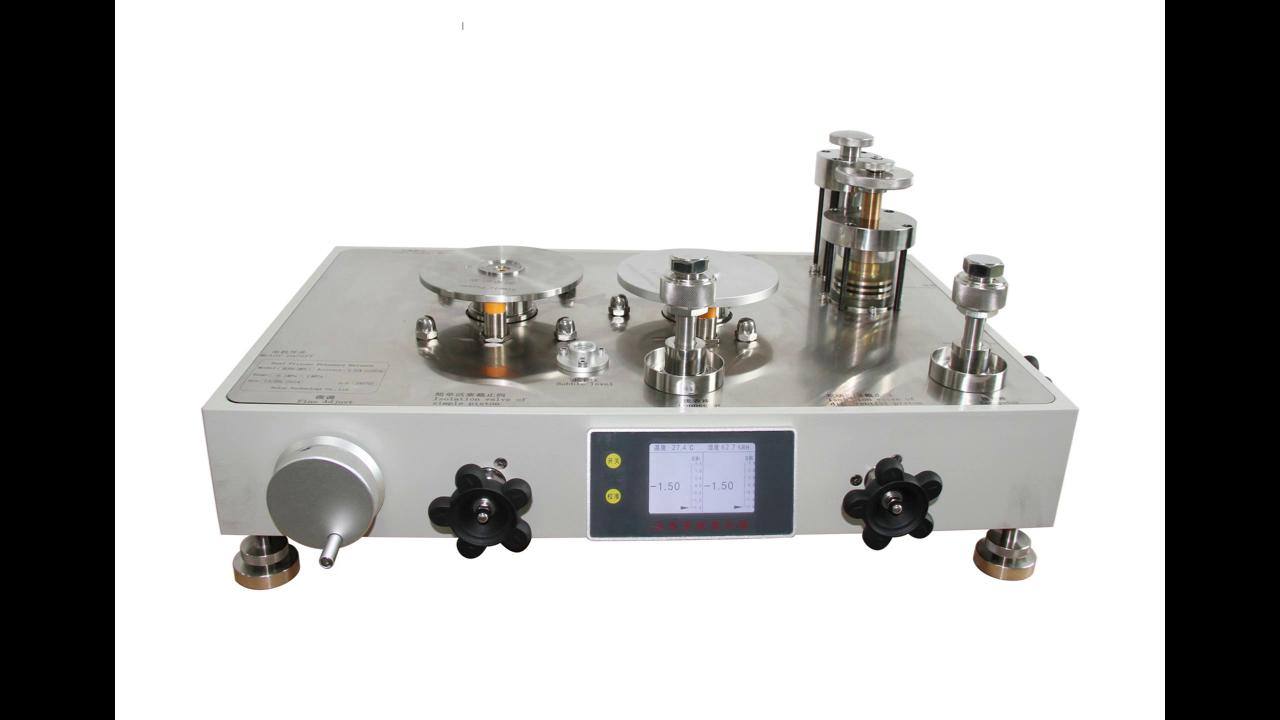
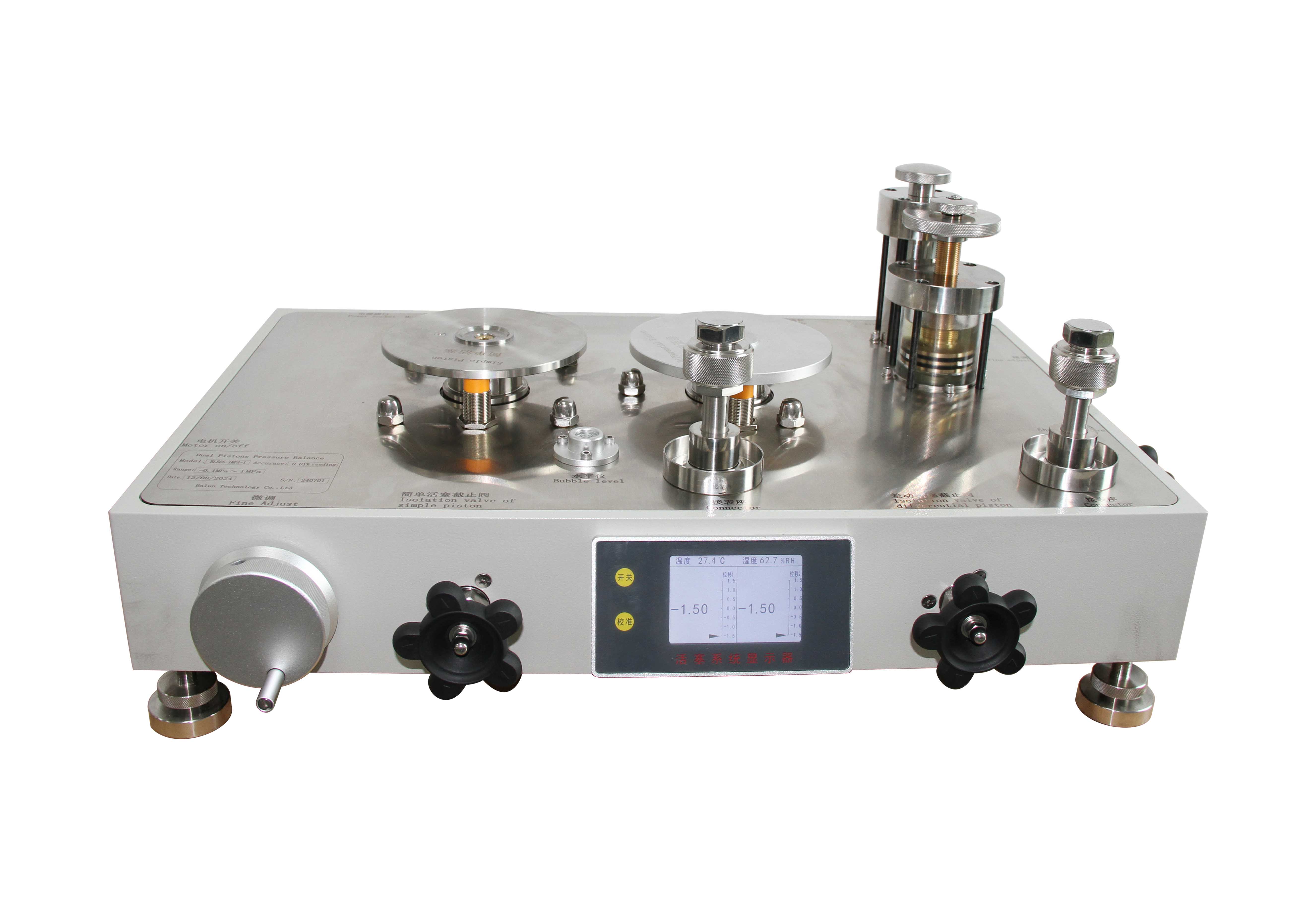
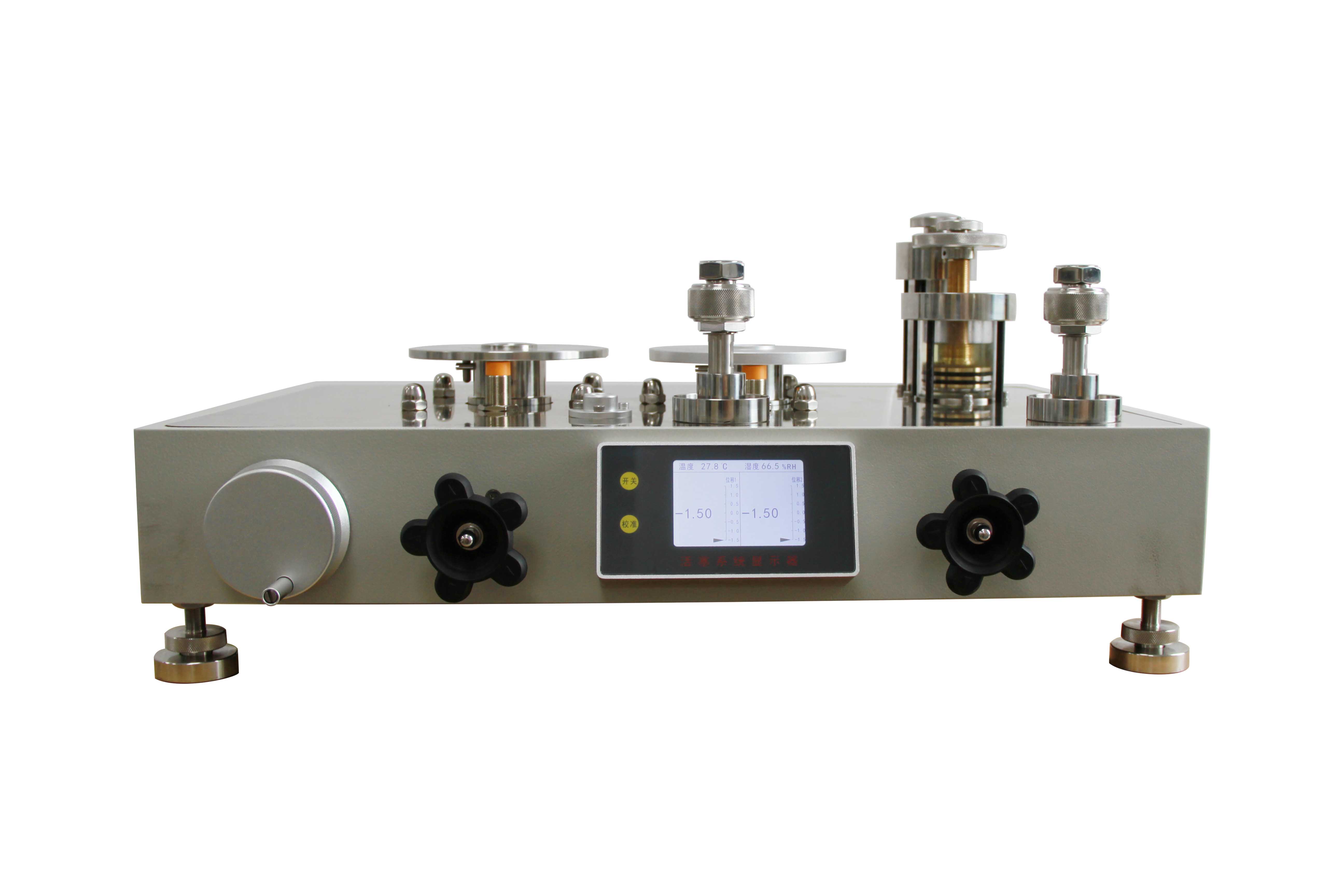
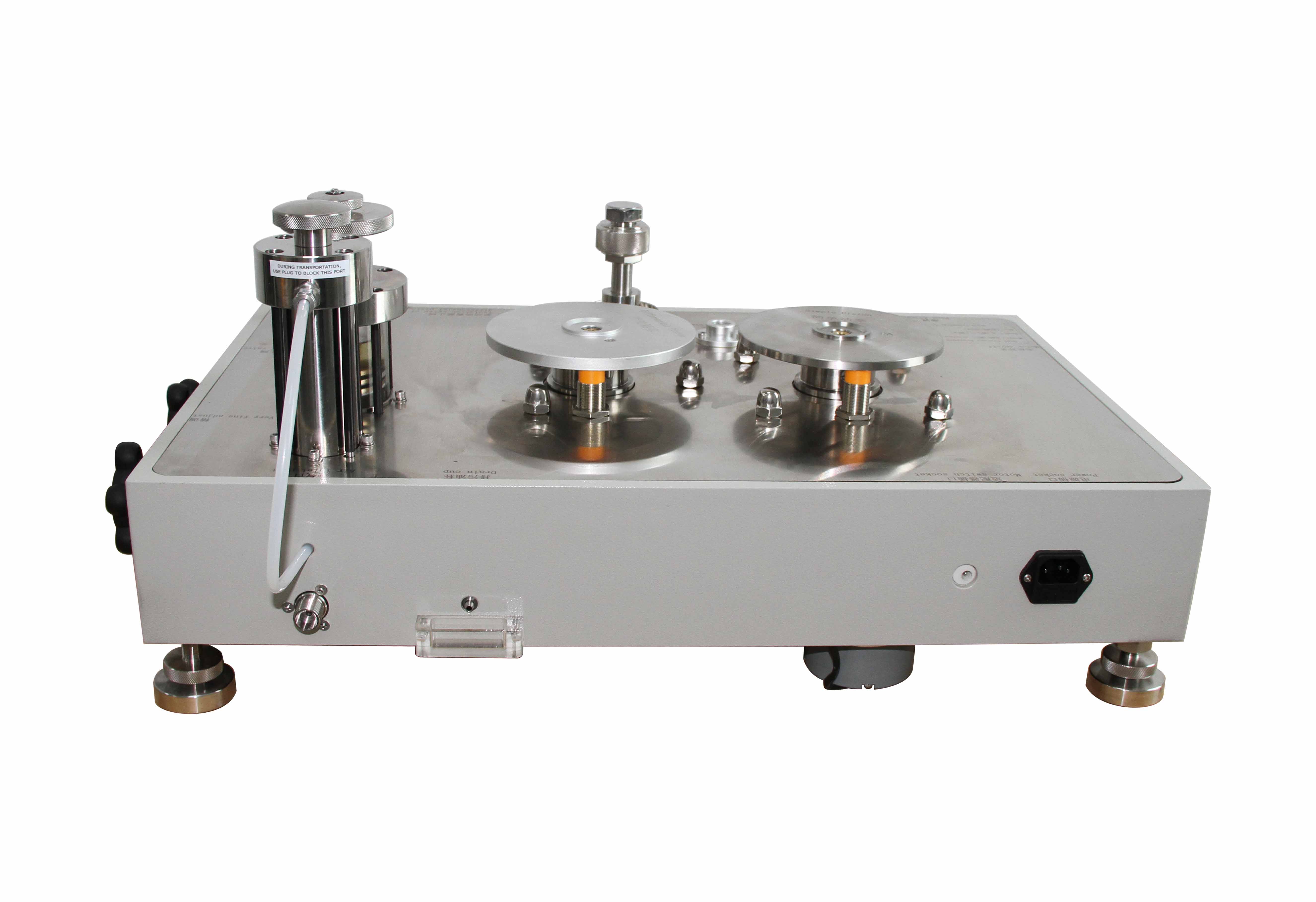
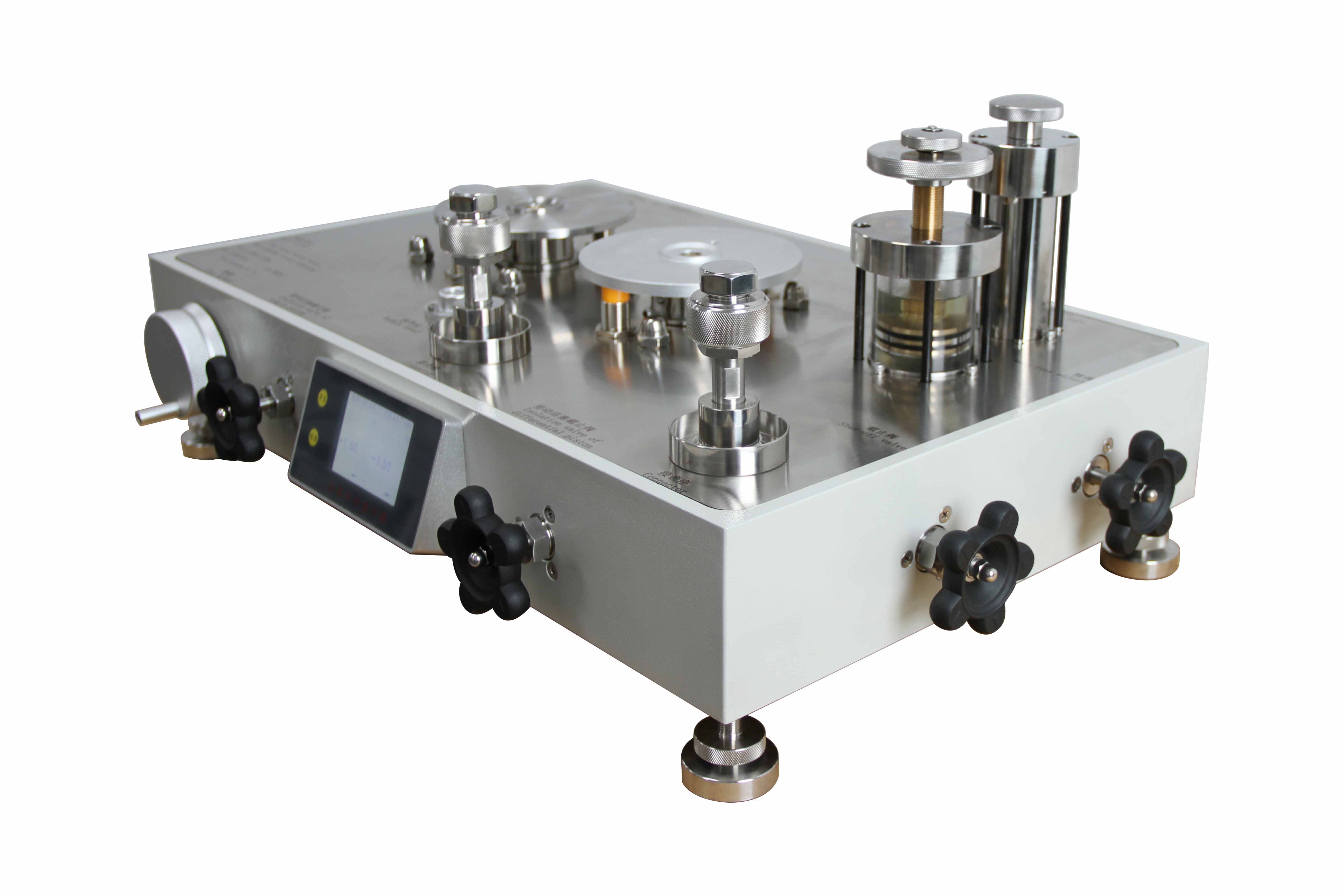
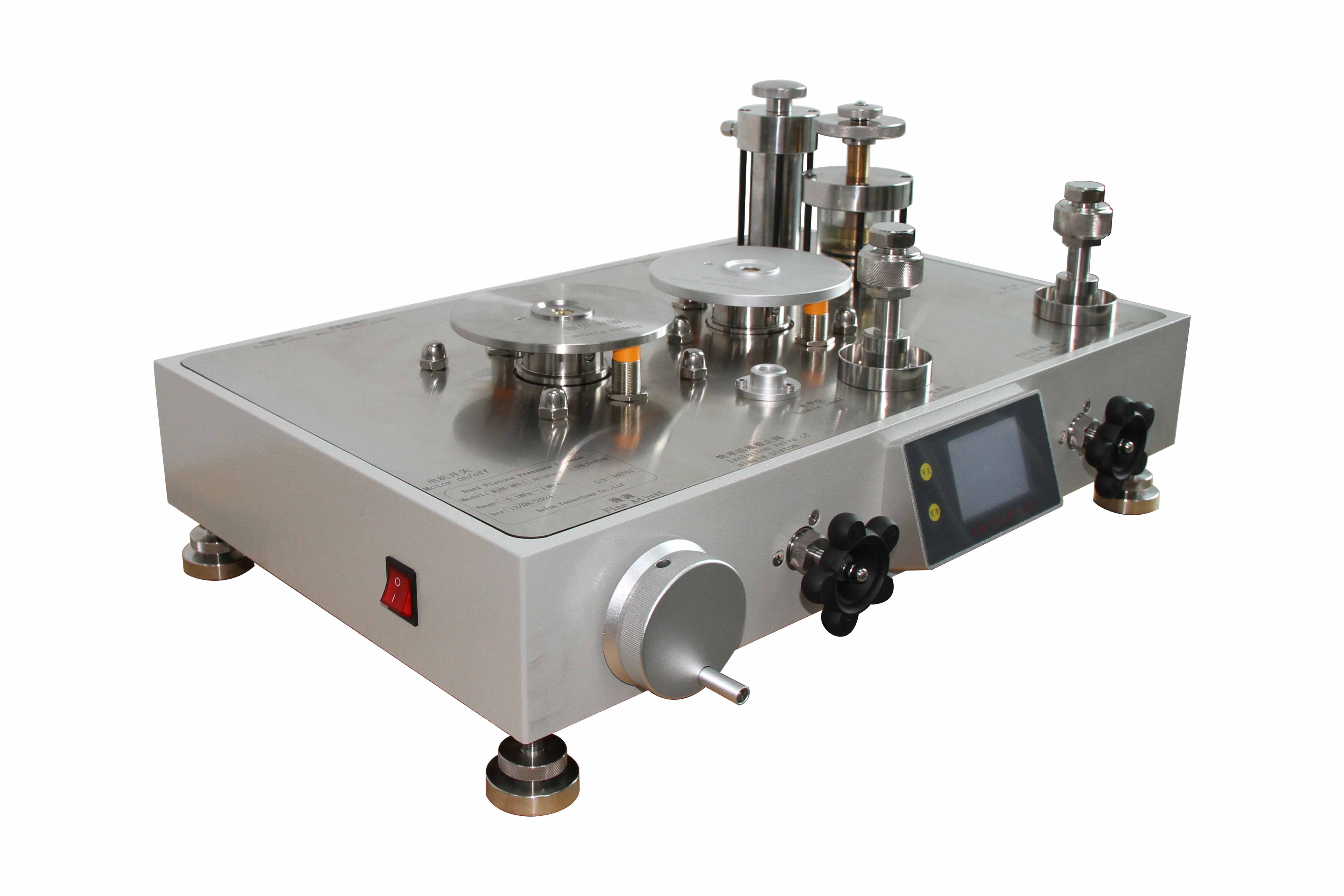
BL505 Dual Pistons Pressure Balance (-100kPa to 1MPa)
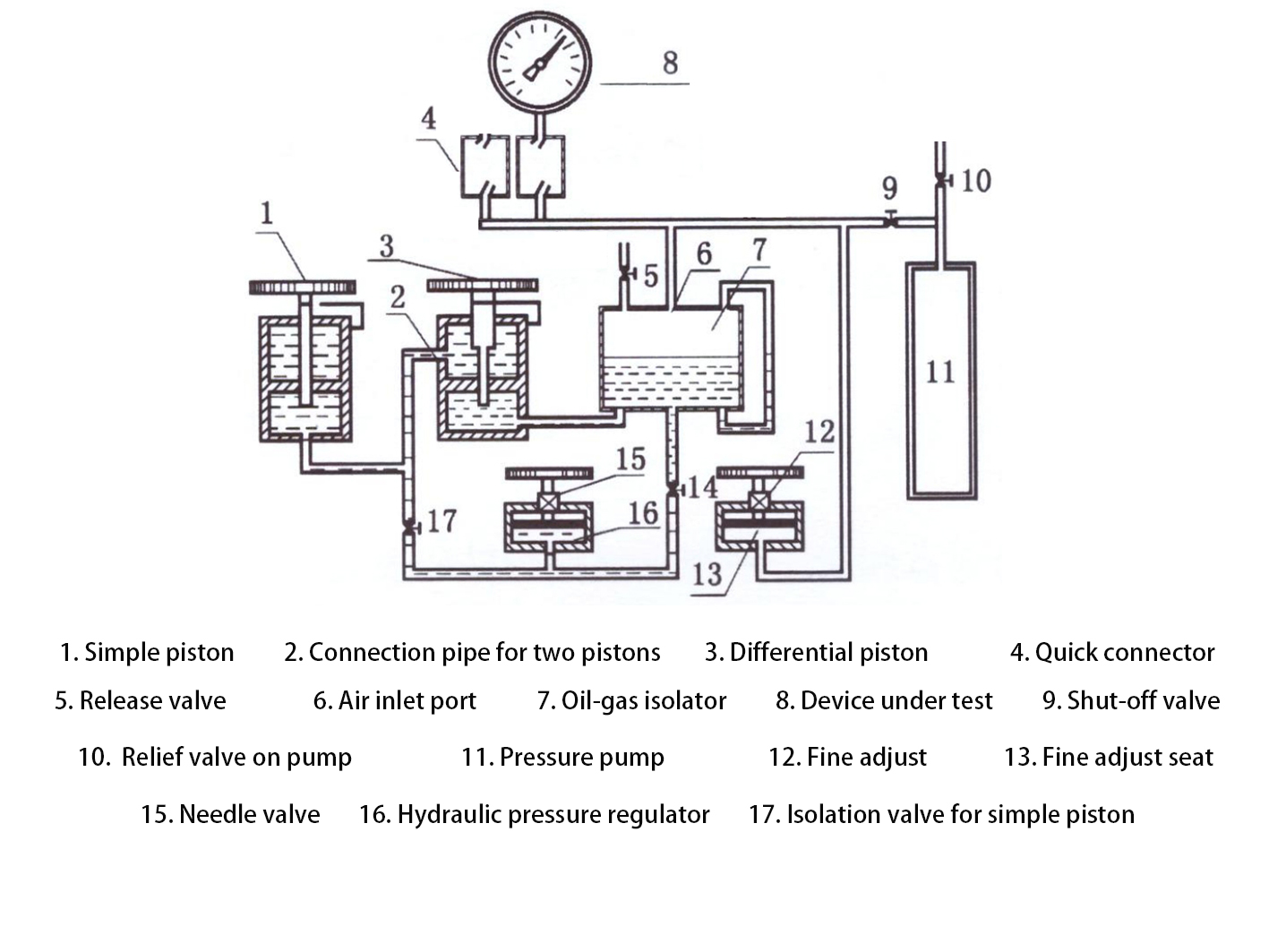
The model BL505 dual piston pressure balance is based on the principle of static pressure, which achieves a force balance system through a master piston and a slave piston. When the system is under positive pressure, the balance of the two pistons is disrupted. The slave piston rises and the master piston falls. In order to restore the original balance of the system, several
weights must be added to the slave piston to restore balance. At this time, the weight of the added weights is the pressure value of the tested system. On the contrary, if negative pressure is introduced to the system, the salve piston falls and the master piston rises. At this time, several
weights must be added to the master piston to balance it, and the weight of the added weights is the vacuum value of the tested system.
FEATURES
-0.1MPa to 0.1MPa pressure range
0.01% of reading, 0.02% of reading accuracy
Motor drives the weight rotating.
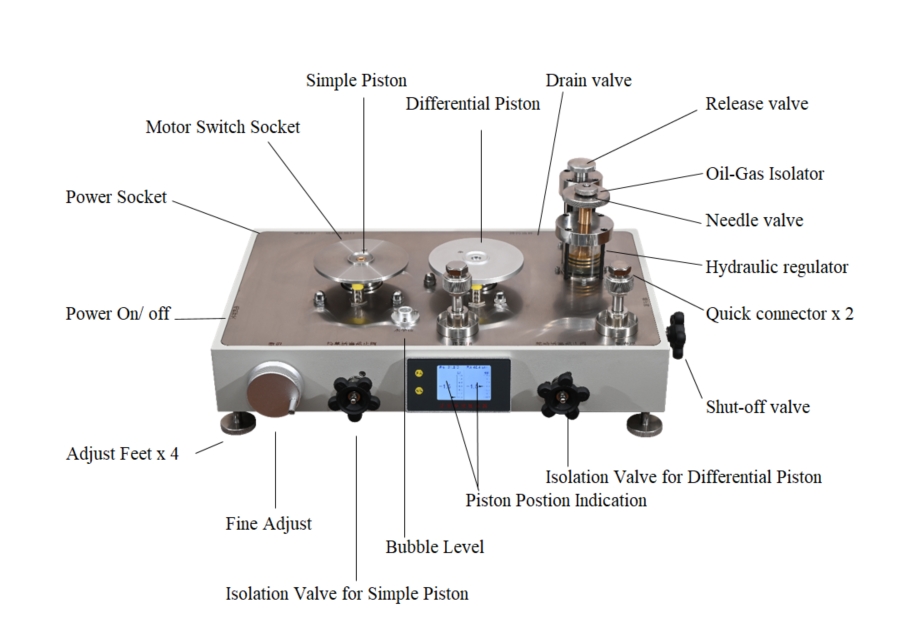
Front LED shows piston position, real temperature and humidity.
The oil pressure regulator and oil gas isolator are equipped with needle valves.
APPLICATION
Calibrate spring tube pressure gauges and precision spring tube vacuum gauges.
Test mercury pressure gauges and non-corrosive industrial pressure gauges.
VIDEO
Youtube video links https://youtu.be/t5qrBBHY6c4
SPECIFICATION
Pressure range: (-0.1~0~0.25) MPa, (-0.1~0~0.6) MPa, (-0.1~0~1) MPa
Accuracy: 0.01%, 0.02%
Piston material: Tungsten Carbide
Cylinder material: Tungsten Carbide
Mass material: 304 stainless steel
Pipe line material: 316L stainless steel
Base material: Aluminum alloy
Medium: Dry air or pure nitrogen driven, oil lubracating
Gravity: Customize to local or standard9.80665 m/s²
Pressure connector: Metric
Power supply: 100-240VAC
Base dimension: 310 mm (H) x 680 mm (L) x480 mm (D)
Base weight: 40kg around
PRESSURE RANGE SELECTABLE SHEET
P/N | BL505-250KPA |
Range | (-0.1~0.25) MPa |
0.01% | < -0.01MPa: ±0.01%; -0.01~0.01MPa: ±1 Pa 0.01~0.25MPa: 0.01% |
0.02% | < -0.01MPa: ± 0.02%; Pa 0.01~0.25MPa: ±0.02% |
P/N | BL505-600KPA |
Range | (-0.1~0.6) MPa |
0.01% | < -0.01MPa: ±0.01%; -0.01~0.01MPa: ±1Pa 0.01~0.6MPa: 0.01% |
0.02% | < -0.01MPa: ± 0.02%; -0.01~0.01MPa: ±2Pa 0.01~0.6MPa: ±0.02% |
P/N | BL505-1MPA |
Range | (-0.1~1) MPa |
0.01% | < -0.01MPa: ±0.01%; -0.01~0.01MPa: ±1Pa 0.01~1MPa: 0.01% |
0.02% | < -0.01MPa: ±0.02%; -0.01~0.01MPa: ±2Pa 0.01~1MPa: ±0.02% |
SCOPE OF DELIVERY
BL505 Dual piston pressure balance base
Piston cylinder unit (x2)
Mass sets (x2)
Mass carrier (x2)
Adapter kits (NPT, BSPP)
Fixtures
Flexible hose
Lead wire (for balancing)
Syringe
User Manual
Warranty
100-240V to 5V-2A DC power adapter
100-240V AC Power cord
OPTIONAL ACCESSORIES AND SERVICES
ISO17025 calibration certificate (P/N: CAL-505)
Manual operated pneumatic hand pump
ORDERING MODEL NUMBER
BL505-250KPA-X
BL505-600KPA-X
BL505-1MPA-X (X is accuracy, 01: 0.01%rd; 02: 0.02%rd)
(Need to inform the local gravity value in advance)
Q: What is the media for BL505 dual pistons pressure balance?
A: Dry and clean air or pure nitrogen gas operated, oil lubracating.
Q: What is the pressure souce for BL505 dual pistons pressure balance?
A: 6MPa pneumatic pressure hand pump.
Q: How to make balance for very low pressure like as 1000Pa?
The low pressure is very sensitive to environment changes.
In order to get a stable pressure sournce, you have to note the fooling tips:
The room temperature is 20℃±0.5℃。
Do not let aircondition flows the air to the instrument direccetly.
Close the door and do not let colleagus moves around.
Do not talk and keep silence
It takes about 30 minutes to make ZERO balance, a little by a little
It take about 10 minutes to make balance at 5kPa.
Application Video?
Why Only theArea of the Differential Piston Is Verified Instead of the Simple Piston Areafor BL505 Dual-Piston Pressure Gauges?
1. Force Balance Formula for Dual-PistonPressure Vacuum Gauges (JJG159)
Define parameters as follows:
Ad: Effective area of the differential piston
As: Effective area of the simple piston
Gd: Dead weight of the differential piston;
Gs: Dead weight of the simple piston
For positive pressure measurement: Themedium pressure p acts on the underside of the differential piston; the uppersides of both pistons are exposed to atmospheric pressure p0
Force balance equation:
p⋅Ad+Gd=Gs+ΔG
where ΔG denotes the total gravitationalforce of weights loaded onto the differential piston.
Rearranged pressure calculation formula:
p=Ad(Gs−Gd)+ΔG
For negative pressure (vacuum) measurement,weights are placed on the simple piston. After formula transformation, thedenominator remains solely Ad; As only appears in the constant term of dead weight difference.
2. Reasons for Verifying OnlyDifferential Piston Area Ad Rather Than SimplePiston Area As
(1) The simple piston area only affects afixed zero offset constant and is excluded from pressure proportionalcalculation
Asis not involved inthe proportional coefficient linking pressure and weight load. The combinedvalue of Gs, Gd and As forms a fixed zero-bias constant AdGs−Gd. This constant is calibrated and offsetonce during factory production or verification. Subsequent pressure measurementrelies entirely on Ad to convert weight force into pressurevalues.
Any area error of the simple piston onlyresults in a constant zero drift, which can be eliminated via zero adjustment,without amplifying measurement errors across the full measuring range.
(2) The differential piston area serves asthe sole reference denominator for pressure conversion
The pressure reading is inverselyproportional to Ad: the main component of measured pressureequals the loaded weight force ΔG divided by Ad. Tinyerrors in Ad will be proportionally amplified atevery pressure point across the full range, directly determining the accuracyclass of the whole instrument. As mandated by verification regulation JJG159,the effective area of the differential piston must be measured on-site withcorrection values provided, while separate verification of the simple pistonarea is not compulsory.
(3) The simple piston acts merely as acounterweight for dead weight balance, with no pressure sensing function
The simple piston only counteracts theself-weight of the differential piston throughout operation; it bears noprocess medium pressure and does not participate in pressure generation. Thedifferential piston is the only measuring element that directly bears hydraulicpressure and converts hydraulic force into balanced weight force, making it thecore metering component.
(4) Area ratio K=AdAs is only used for auxiliaryverification, eliminating the need for independent precise measurement of As
The area ratio K is measured underregulation specifications to cross-check zero position and balance consistency,yet separate high-precision calibration of As isunnecessary. Once the reference area Adis accuratelydetermined, paired with weighed dead weight differences, full pressure valuescan be completely calculated. Minor manufacturing deviations in As only alter the zero point, and the range slope is fully governed byAd.
Plain Summary
Differential piston = Core measuring component: Pressure magnitude is converted from weight load exclusively using its area. Its dimensional precision dictates overall instrument accuracy and requires rigorous inspection.
Simple piston = Balance counterweight: It only offsets piston self-weight. Its area deviation merely causes fixed zero drift, removable by zero tuning, with no impact on range proportional precision—hence no separate area verification is required.