
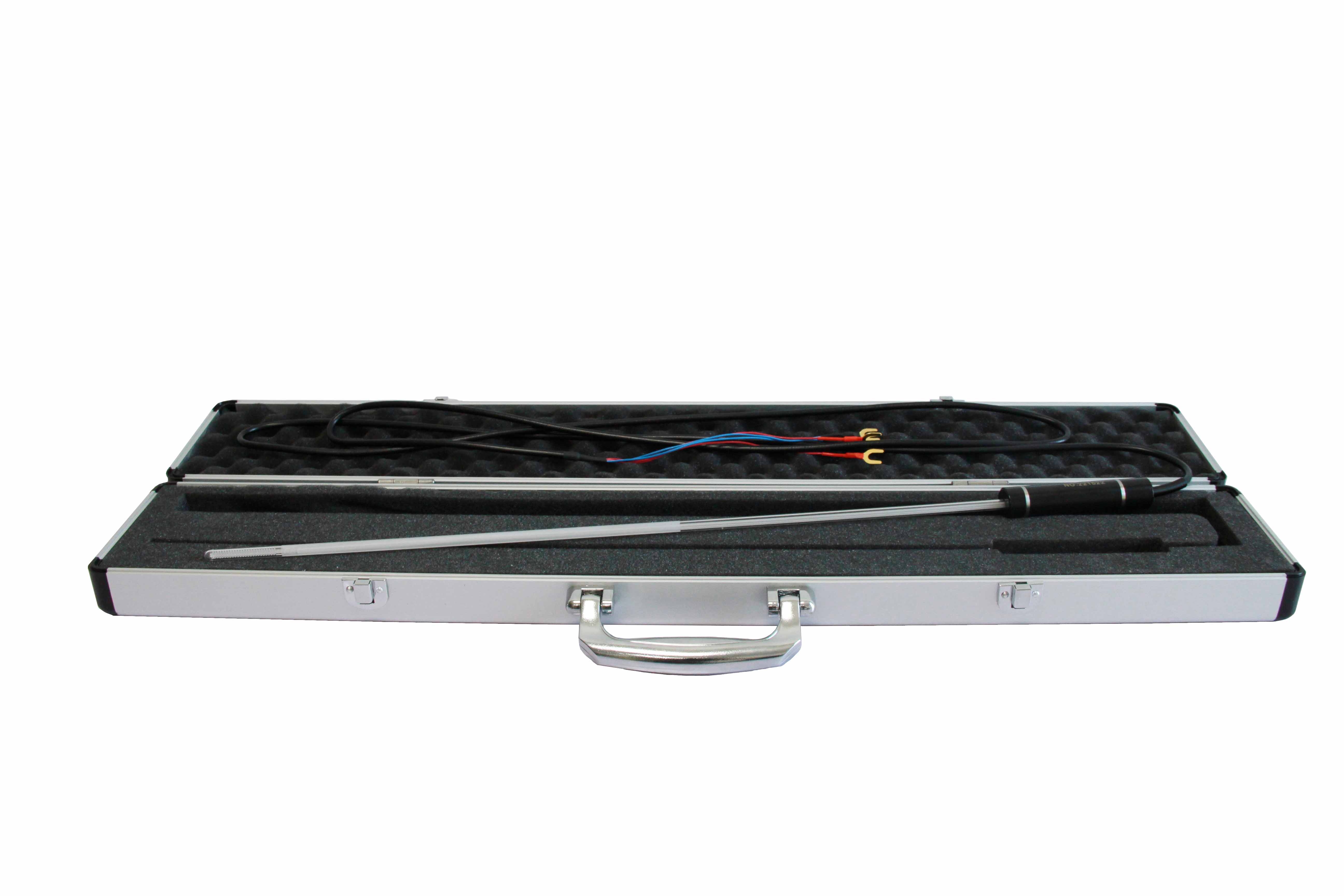
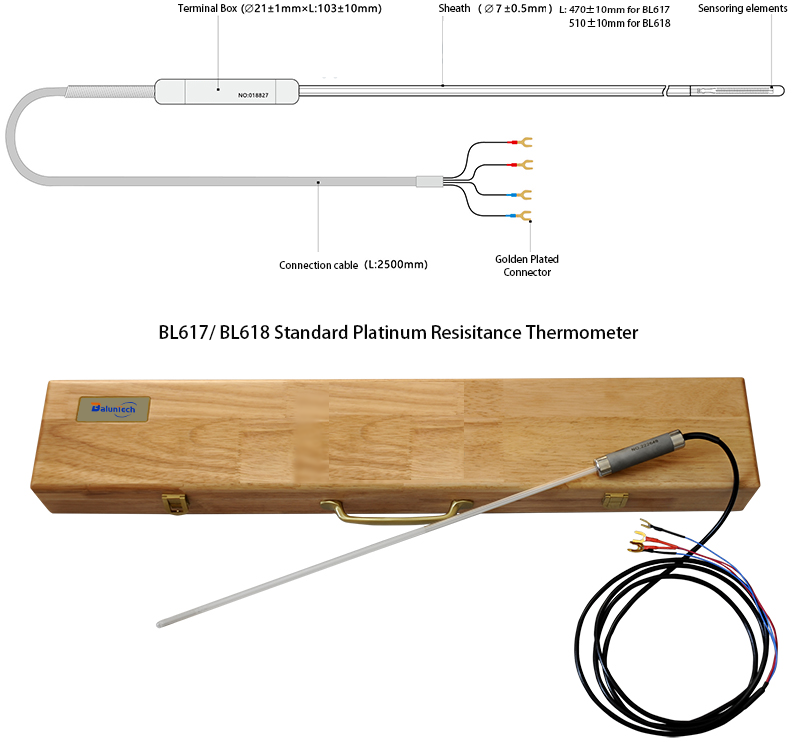
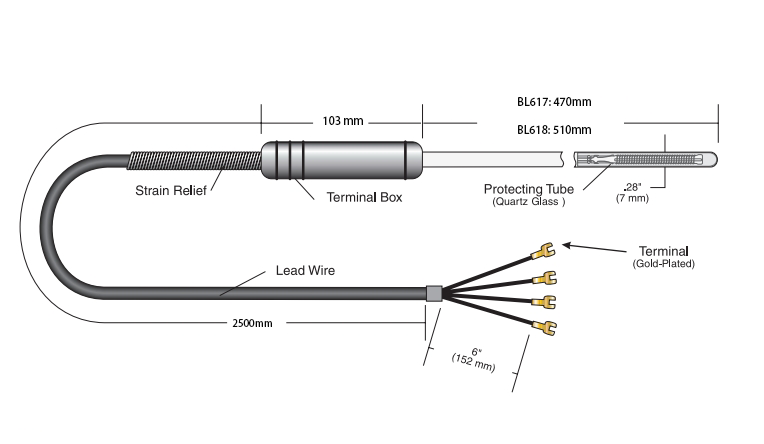
BL618 Standard Platinum Resistance Thermometer (0...661℃)
The Standard Platinum Resistance Thermometer (SPRT) is a kind of device to measure temperature through a change in electrical resistance of a length of wire. SPRT is the stipulated interpolation instrument for realizing the International Temperature Scale of 1990 between the defining fixed points, over the range from 13.8033 K (the triple point of equilibrium-hydrogen, -259.3467℃) to 961.78°C (the freezing point of silver). The transfer function of the SPRT is electrical resistance as a function of temperature; therefore an accurate measurement of resistance, referred to a fixed resistance base, is an essential component of the measurement chain.
KEY FEATURES
Ranges from 0°C to 661°C
Fused quartz sheathed
W(Ga)≥ 1.11807, W(Hg) ≤ 0.844235
Resistance at 0°C (Rtpw): 25Ω
Meets all ITS-90 requirements
APPLICATIONS
Reference thermometer for very accurate temperaturemeasurements
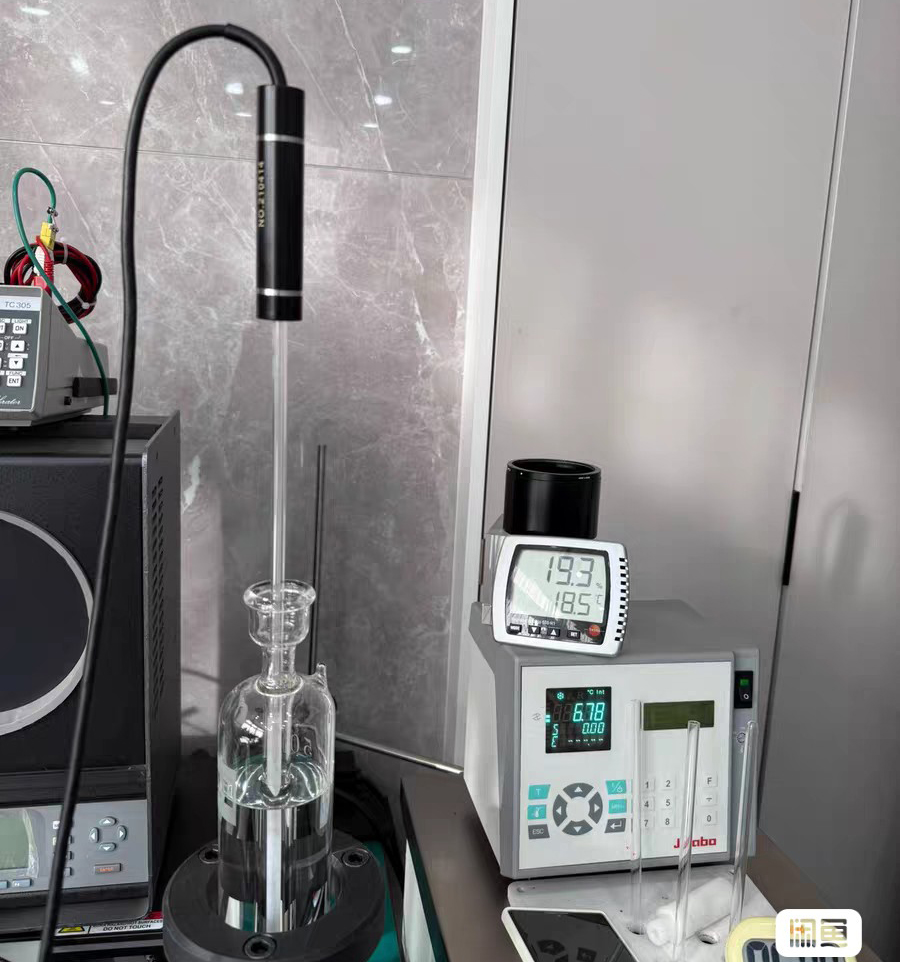
Comparative calibration in tube furnaces and liquid baths
SPECIFICATION
Part Number | BL618-6 | BL618-7 | BL618-8 |
Annual drift @0.01°C | ≤ 0.5mk | ≤ 1mk | ≤ 3mk |
Stability | ≤ 2mk | ≤ 4mk | ≤ 8mk |
Self-heating | ≤ 1.5mk | ≤ 2.5mk | ≤ 3mk |
Temperature Range | 0°C to 661°C | 0°C to 661°C | 0°C to 661°C |
Rtpw | 25.5Ω ± 0.5 Ω | ||
Resistance ratio | W(Ga)≥ 1.11807, W(Hg) ≤ 0.844235 | ||
Measurement Current | 1mA | ||
Platinum diameter | 0.05mm | ||
Sensor length | 60mm | ||
Sensor material | Platinum | ||
Head diameter | φ21mm | ||
Head length | 103mm | ||
Sheath diameter | φ7 ±0.5mm | ||
Sheath length | 510±10mm | ||
Sheath material | Quartz | ||
Insulation Resistance | >1000 M ohm at room temperature | ||
Characterizations | ITS-90, IEC-751(DIN 385) | ||
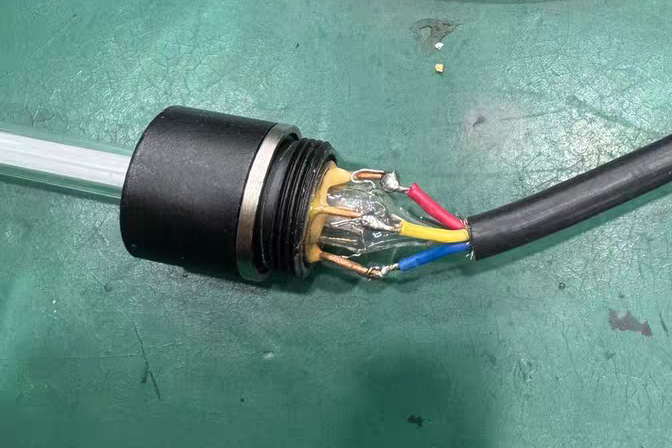
Cable | 2m PTFE insulated copper wire cable | ||
Connection leads | Four Gold-plated Copper Spades | ||
Gas in sheath | Inert gas | ||
SCOPE OF DELIVERY
BL618 Standard platinum resistance thermometer
Wooden carrying case
OPTIONAL ACCESSORIES AND SERVCIE
ISO17025 Calibration Certificate
Precisioin Reference Thermometer BL625
High Precision Reference Thermometer BL621
ORDERING MODEL #
BL618-6: SPRT, 0°C to 661°C, ≤ 2 mk stability
BL618-7: SPRT, 0°C to 661°C, ≤ 4 mk stability
BL618-8: SPRT, 0°C to 661°C, ≤ 8 mk stability
Difficulties in Manufacturing and TestingStandard Platinum Resistance Thermometers (SPRTs)
1. Core Difficulties in Manufacturing Process
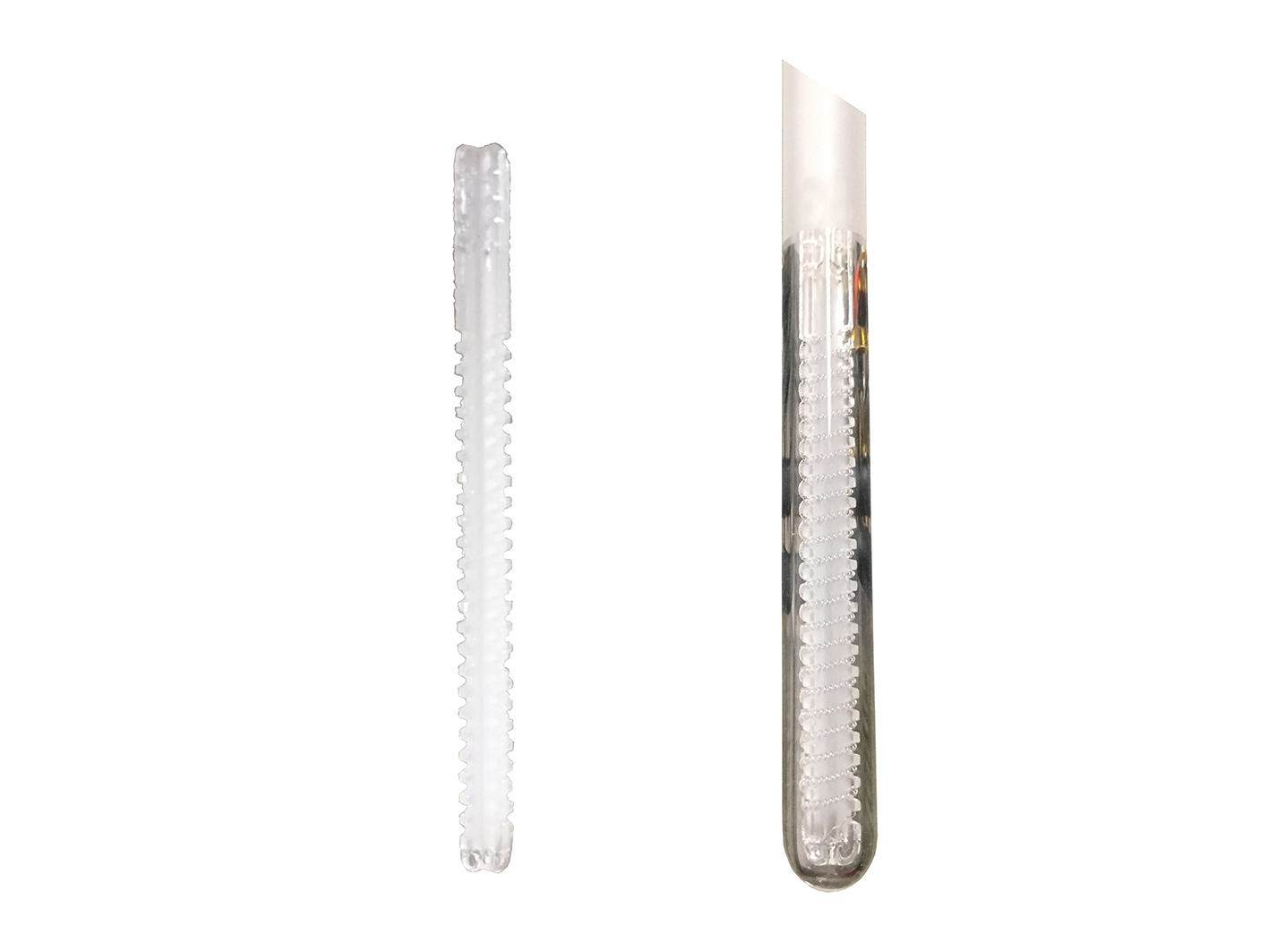
1.1 Ultra-high purity and stress-free winding of platinum wire sensing element
The sensitive core of a standard platinum resistance thermometer adopts 6N high-purity platinum wire (99.9999%), far higher than the 4N~5N platinum used for industrial PRTs.
Trace impurities such as iron, silicon, carbon, copper will cause irreversible resistance drift under long-term high / low temperature cycling. Raw platinum must undergo vacuum zone refining to control impurities at ppm level, with extremely strict raw material screening.
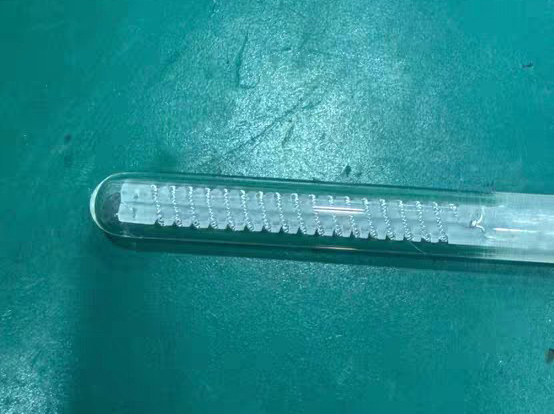
The platinum wire must be wound into a coil in a completely stress-free framework. Any tensile, bending or forming residual stress will change the crystal lattice structure of platinum, leading to gradual drift of the triple-point resistance value Rtp of water during service. Unlike industrial thin-film platinum resistors that allow stress packaging, SPRT requires precise loose winding inside a quartz capillary to eliminate mechanical stress completely.
Even tiny vibration or slight extrusion during assembly will introduce hidden stress, resulting in scrapping of finished products.
1.2 Strict control of axial resistance uniformity
The resistance-temperature characteristic of the entire platinum wire coil from the measuring end to the lead wire end must be highly consistent.
Local component segregation, uneven wire drawing grain size or inconsistent annealing will cause axial non-uniformity. When the SPRT is inserted into different depth positions of a constant-temperature furnace, the effective sensing segment changes, leading to different measured resistance values and introducing large gradient errors for temperature value transfer.
Industrial PT100 only inspects the sensing head, while standard SPRT needs full-length uniformity testing; once local uniformity exceeds the tolerance, the whole thermometer is rejected, resulting in very low production yield.
1.3 High-precision multi-stage annealing for stress relief
All processes including wire drawing, cutting, winding, lead welding will produce residual stress. SPRT must go through segmented, stepped high-temperature annealing and slow programmed cooling:
Multiple cycles of high-temperature heat preservation (usually above 600℃) followed by ultra-slow cooling to release internal stress thoroughly. Improper holding time, heating / cooling rate will directly lead to long-term annual drift out of tolerance.
After annealing, the thermometer needs to be placed for aging stabilization for several weeks to eliminate latent stress drift before subsequent calibration. Most industrial platinum resistors only perform simple low-temperature stress relief or skip annealing steps.
1.4 Hermetic high-purity sealing and high-insulation packaging
1.4.1 The platinum coil is encapsulated inside a high-purity quartz glass tube, filled with dry high-purity argon and hermetically vacuum-sealed: Argon inert gas can prevent platinum from oxidation andcon tamination by water vapor, impurity gas at high temperature; slight air leakage will cause gradual oxidation of platinum wire and permanent drift of Rtp.
1.4.2 High-purity magnesium oxide powder or dense alumina insulating support must be adopted: Ordinary insulating materials will release volatile impurities at high temperature, causing platinum pollution. The insulation resistance between platinum coil and sheath must maintain GΩ-level insulation performance from cryogenic to high temperature to avoid leakage current-induced measurement error.
Quartz sheath is brittle and cannot bear bending, impact or thermal shock. The structural design must avoid thermal stress caused by different thermal expansion coefficients between platinum, insulating filler and quartz tube.
1.5 Precise matching of four-wire lead structure
SPRT uniformly adopts four-wire connection to completely eliminate lead resistance error. The two current leads and two potential leads must use the same material platinum wire, with consistent length and temperature field distribution at the reference end. Different lead temperatures will generate parasitic thermoelectric potential, interfering with tiny resistance measurement of the platinum coil.
2. Core Difficulties in Calibration and Testing
2.1 Dependence on ITS-90 fixed-point temperature standard devices for primary calibration
To obtain metrological certification as a standard thermometer, SPRT must be calibrated at multiple ITS-90 defined fixed points (equilibrium hydrogen triple point, neon triple point, oxygen triple point, water triple point, tin freezing point, zinc freezing point, silver freezing point, etc.):
Each fixed-point device has extremely strict requirements on gas purity, container material, temperature stabilization time and environmental heat insulation. The water triple-point cell alone needs constant temperature pre-stabilization for dozens of hours to ensure a stable 0.01℃ fixed temperature field.
A full-range SPRT fixed- point calibration cycle often lasts several weeks, with extremely high time cost and equipment investment. Industrial precision platinum resistors only adopt comparative calibration in constant-temperature baths without fixed-point calibration.
2.2 Ultra-precise measurement of tiny resistance signals and anti-interference requirements
SPRT usually adopts the nominal resistance of 25 Ω at 0 ℃, with an extremely small resistance change rate with temperature, requiring high-precision DC resistance measuring bridges with nΩ-level resolution for testing:
Excitation current must be strictly limited (typically ≤0.1 mA) to suppress self-heating effect; excessive current will cause the platinum coil to heat itself and produce measurement deviation.
The test laboratory needs electromagnetic shielding, constant-temperature environment, isothermal connection terminals and fully shielded four-wire measuring cables to eliminate contact resistance, parasitic thermal potential and power-frequency interference. Tiny external interference will directly lead to distortion of resistance test data.
2.3 Multi-dimensional stability verification test items
Before being graded as first-class or second-class standard instruments, SPRT must pass a series of long-term reliability tests:
Short-term repeatability test: Multiple repeated immersion measurements at fixed points to verify measurement reproducibility, requiring resistance fluctuation within mK level.
Temperature cycle stability test: Multiple rounds of cryogenic–high temperature cyclic impact, inspecting the variation of water triple point resistance before and after cycling to evaluate residual stress release.
Long-term thermal aging drift test: Continuous high-temperature holding for hundreds to thousands of hours to characterize annual drift; only thermometers with annual drift less than 8 mK~15 mK can be used as metrological transfer standards.
Industrial platinum resistors rarely carry out the above long-term aging and cyclic stability tests.
2.4 Complex measurement uncertainty evaluation and metrological traceability
The calibration chain must be traced back to national temperature primary standard fixed-point devices level by level. Every link of standard instruments, measuring bridges, constant-temperature equipment must hold valid metrological certificates.
When issuing a formal SPRT verification certificate, it is necessary to establish a complete mathematical model to evaluate dozens of uncertainty components: fixed-point temperature deviation, measurement bridge error, lead parasitic potential, self-heating error, temperature field uniformity, measurement repeatability, resistance drift, etc., involving complex Type A and Type B uncertainty synthesis calculation, with extremely high requirements for metrological professional capability.
3. Additional Difficulties in Application and Quality Control
Strict transportation and usage restrictions: SPRT cannot be vibrated, squeezed, bent or subjected to rapid thermal shock; slight mechanical impact will introduce internal stress and cause irreversible drift, leading to standard instrument failure.
Full life cycle traceability management: Each standard platinum resistance thermometer has a unique serial number, with complete records of raw material inspection, winding parameters, annealing curves, sealing process, fixed point calibration data, stability test reports and historical verification records, which must comply with national metrological quality system regulatory requirements.
Summary of Core Difficulties Compared with Industrial Precision PRTs
Industrial precision platinum resistors: Adopt thin-film platinum chip, ordinary annealing process, comparative calibration in constant-temperature equipment, only single point precision inspection, no fixed point calibration and long term aging test, low process threshold and short production cycle.
Standard platinum resistance thermometers: Constrained by ultra-high-purity raw materials, stress-free precision winding, multi-stage programmed annealing, hermetic inert gas sealing, ITS-90 fixed point calibration, long-term stability aging test and complex uncertainty evaluation, featuring low finished product yield, long manufacturing and testing cycle, high investment in precision equipment and metrological technology threshold.