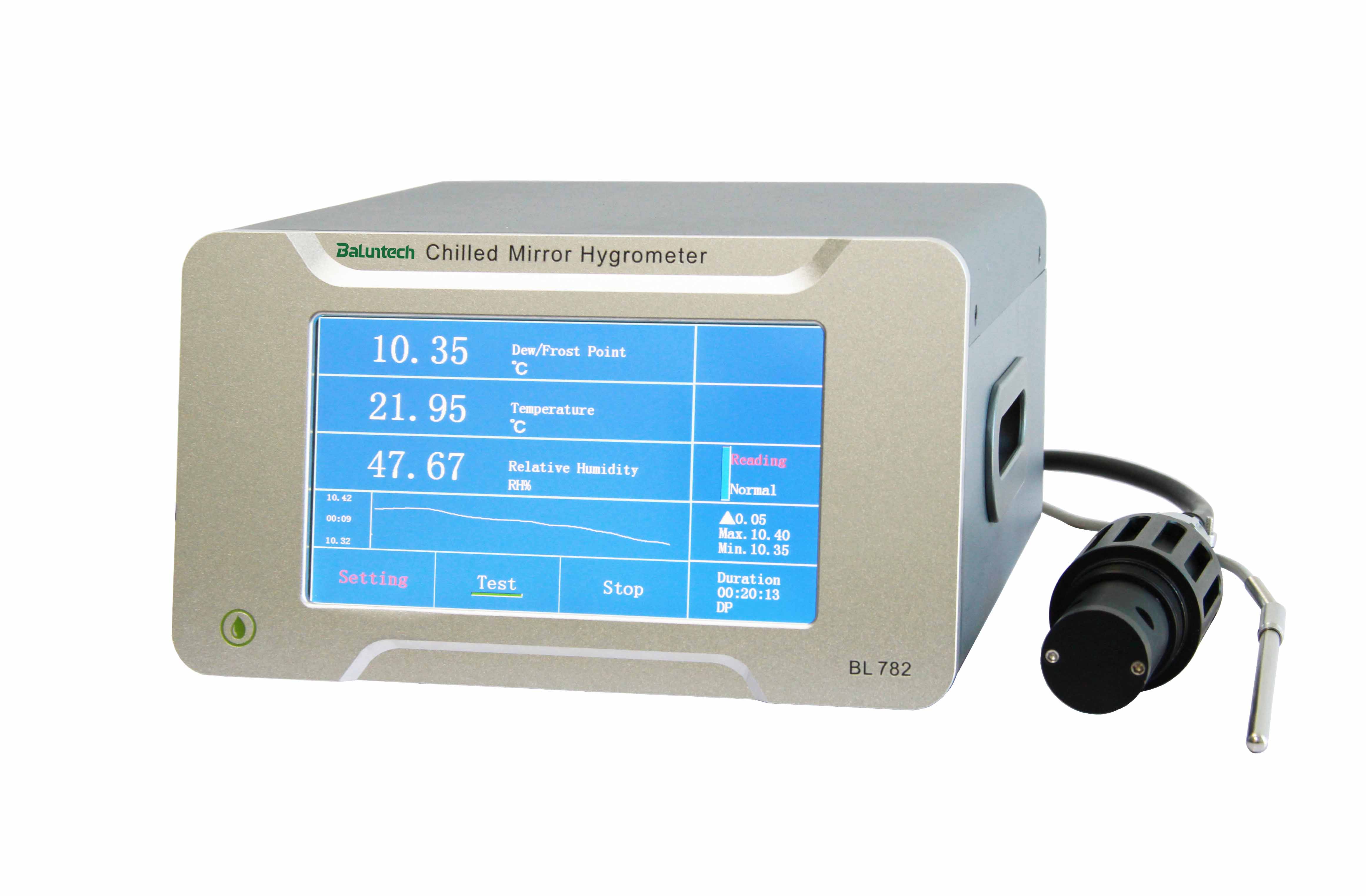
Why select a Chilled Mirror Hygrometer?
Why select a Chilled Mirror Hygrometer?
The chilled mirror hygrometer dew point has several distinct advantages over other water vapor sensing technologies:
A chilled mirror hygrometer provides one of the few truly direct physical measurements of humidity. It is recognized as the most precise method of determining the water vapor content of a gas above 5% RH. Use it when you need maximum precision of measurement.
The CHILLED MIRROR HYGROMETER's optical sensor is a totally inert device. The sample gas contacts glass and non-reactive metals. Thus, it can be easily cleaned and can last indefinitely. Use it when the gas sample contains contaminants and particulates, which would damage other types of humidity sensors.
Unlike polymer RH sensors, lithium chloride dew cells, and other chemically-based sensors, a chilled mirror sensor does not lose its calibration. Use it when you need long-term calibration stability.
The dew/frost point temperature defines the saturation point for the water vapor in the gas. From this unique equilibrium temperature, all other reporting formats of gas humidity can be derived. With measurements of gas temperature and pressure, other reporting forms for humidity can be derived.
Where Chilled Mirror Hygrometer Work Best?
Metrology.
A properly designed and maintained Chilled MirrorHygrometer provides measurements with uncertainties several orders of magnitude less than those of other popular humidity sensors. The Chilled MirrorHygrometer's inherent precision, especially when equipped with a 4-wireplatinum resistance thermometer to measure the mirror temperature and a medium-power microscope to monitor the mirror condition, makes it an ideal ISO17025 traceable transfer standard.
Environmental Testing.
The Chilled Mirror Hygrometer is ideal for measuring absolute humidity in the environmental test laboratory. It is often used as an ISO17025 traceable standard to monitor the accuracy of other instruments such as the relative humidity sensors used to control environmental test chambers.
Furnace Atmospheres and Highly Contaminated Environments.
The inert nature of the Chilled Mirror Hygrometer renders it impervious to most contaminating substances and allows it to be repeatedly cleaned, resulting in very long-term sensor life without loss of calibration. These inert characteristics make it well suited for use in gas streams where high levels of contaminants in the sample gas would render less inert types of humidity sensors in operable. For example, Chilled Mirror Hygrometers are widely used to monitor dew points of car buerizing atmospheres employed in the heat treating of metals. In such applications, easy access to the mirror for cleaning is especially desirable.
Moisture-Sensitive Manufacturing.
The specialized packaging environments required in the manufacture of pharmaceuticals, films, coatings, and other products are often monitored with Chilled Mirror Hygrometers. Again, their long-term precision and ISO17025 traceability make them the instruments of choice. Further more, because these processes are usually less sensitive to instrumentation costs, the higher price of Chilled Mirror Hygrometers is less a factor in selecting a humidity-monitoring scheme.
High-Temperature Gases and Dew Points.
Chilled Mirror Hygrometer sensors are frequently chosen for the measurement of dew point temperatures above ambient temperature. Air- and water-chilled sensors were built as far back as 1966 to monitor early Apollo hydrogen fuel cells operating at 250°C and 700 psig. With today's thermoelectric cooling technology, dew points up to 100°C (and higher, assuming above-atmospheric pressures are present) are readily handled. In such applications, all surfaces in contact with the sample gas must be held at a temperature higher than the highest dew point anticipated; otherwise, condensation will occur on these surfaces and the measurement will be in error. Sample lines must also be heated. Insensors intended for high-temperature dew point applications, it is common practice to use electrical cartridge heaters with thermostatic control to maintain the sensing cavity walls above the highest dew points anticipated. Solid-state optical components such as LEDs and detectors are therefore held at a temperature below their rated operating temperatures (typically 85°C) to prevent their deterioration and ultimate failure. This can be accomplished by thermally isolating these components from the heated sensing compartment.
. . . and Where They Don't ?
Some applications are unsuitable for Chilled Mirror Hygrometer devices. Here are a few tips on where not to use them.
Gases That React with Water.
Reactive gases such aschlorine, oxides of sulfur, and ammonia tend to gradually react with the water dew deposit on the mirror, forming an acid or caustic that causes incorrect (i.e., higher than normal) equilibrium dew point readings. Of course, some applications such as the measurement of condensables in stack gases require measurement of acid dew points. In general, measurements of humidity in water-reactive gases have long challenged the industrial process engineer and, short of laboratory analytical methods, they remain unsolved.
Gas Mixtures Where the Gas Vapor Dew Point Is Higher Than the Water Vapor Dew Point.
A Chilled Mirror Hygrometer measures absolute humidity in terms of dew point temperature. As the mirror cools to the dew point, it will tend to control on the first condensate that occurs. For example, in the case of methane/watervapor mixtures, especially at the well head, the methane dew point is often higher than that of the water vapor dew point, and the instrument will control on and read out the methane dew point rather than the water vapor dew point. In the manually operated "Dew Point Tester," the user can over ride this condition by simply ignoring the buildup of the methane deposit and continue chilling the mirror until the water vapor dew point is reached. This is not possible in the automatic Chilled Mirror Hygrometer, and such applications should be avoided.
Compromises Required at Very Low Dew/Frost Point Measurements.
The degree to which the mirror can be chilled, i.e., depressed below the heat sink temperature, and hence the lowest dew or frost point that can be measured, is determined by the capabilities of the cooling method. Thermoelectric (TE) devices (Peltier coolers) are available as staged arrays, but devices with more than three stages offer only marginal improvement in cooling capability and are increasingly fragile with a tendency to failure. The amount of mirror surface cooling that can be reliably achieved with a two-stage TE device is limited to~65°C below the heat sink temperature at ~25 °C. That is, from room temperatures of 25°C, frost points measurements are limited to about –40°C A finned heat sink design with forced-air cooling ensures that the heat sink does not rise above room temperature, thereby reducing the sensor's depression capability.
A third stage of TE cooling can provide a few more degrees of cooling capability. Use of an integrated auxiliary cooling loop for chilled water or glycol to assist in removing heat from the hot side of the TE heat pump allows lower frost point temperatures to be measured. As a generalization, however, chilled mirror hygrometers become unwieldy and expensive for measuring frost pointsbelow about –70°C Most industrial gases at low water vapor levels aretypically "clean," i.e., they have minimal contaminants, and the inert advantages of the chilled mirror sensor are not so evident. Other types of humidity sensors are often the better choice for very low humidity measurements, especially if the gas is free of contaminants and where the precision offered by the Chilled Mirror Hygrometer is not required.